Emerging Technology Alert: Ambient AI Listening in Healthcare
A new AI has entered the healthcare arena and it’s listening to your most personal moments.

I worked in healthcare for nearly 15 years before exiting the industry, right before COVID hit. Good timing, I guess! I was there to see the surgery center I worked in, transition from paper charts to Electronic Medical Records, as well as changing EMR systems. Twice. Most of my ideas about AI in healthcare will draw from my previous professional experience. Hopefully this post will leave you feeling empowered and more knowledgeable, the next time you find yourself in a healthcare situation.
Ambient AI Listening Devices - Healthcare
There’s a new kid on the healthcare block and its main job is to listen, record and transcribe. This ‘all ears’ device can be found in the category of ‘Ambient AI Listening’ devices. I can tell you one thing for sure: charting can be very burdensome for clinicians. Depending on various regulatory requirements, the type of charting, workflow integration and how fast it needs to get done - will all drive the level of burden for the clinician. So I’m really not surprised to see this area of healthcare offered a solution for an easier workflow.
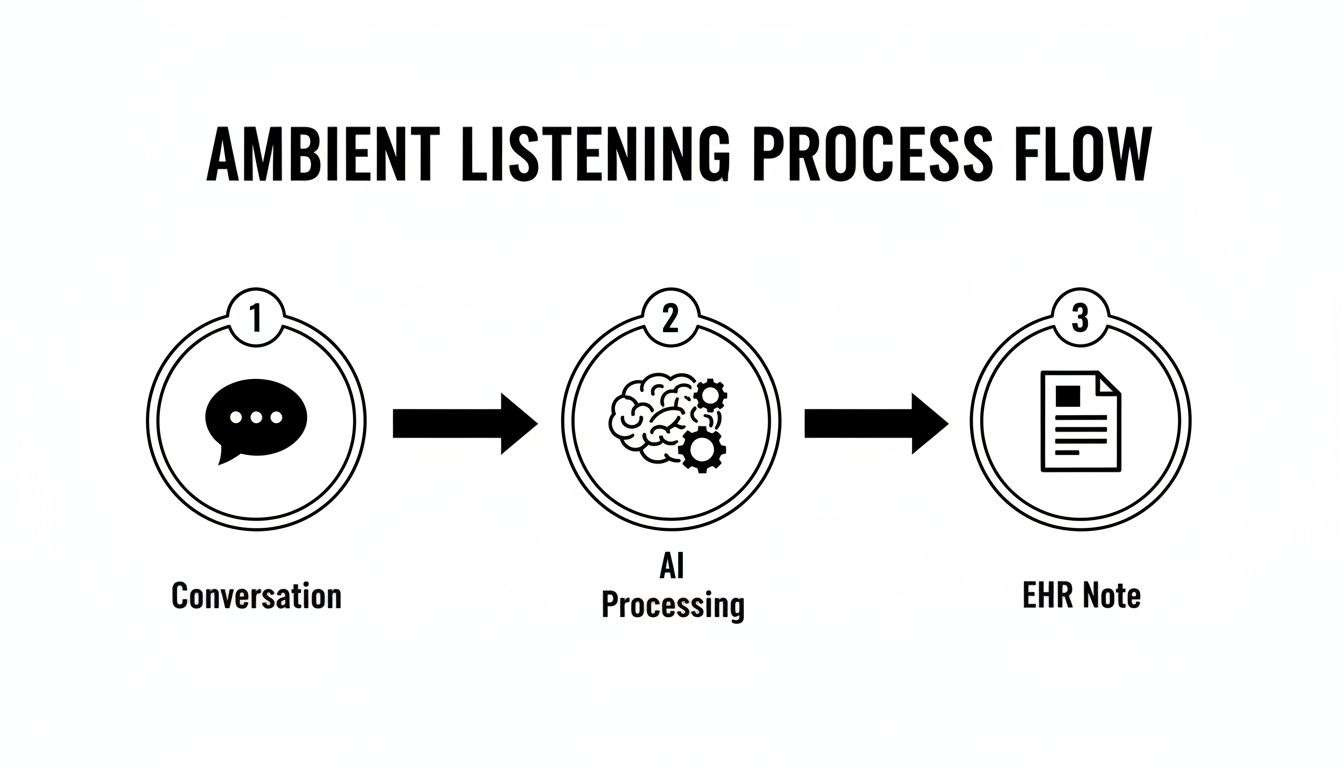
What do they do? Ambient AI listening tools work in a passive manner, by capturing audio from patient - clinician conversations using microphones. It will then apply automatic speech recognition (ASR), speaker diarization (to distinguish patient from clinician), and large language models (LLMs) to transcribe, interpret, and structure the dialogue into clinical notes.
Where can Ambient AI Listening Devices be found?
These devices have already hit the scene in major healthcare systems like the Mayo Clinic, University of Iowa Health Care, Walter Reed, McChord Clinic, Kettering Health, Sutter Health, Atrium Health/Wake Forest, University of Kansas Medical Center, Intermountain Health, Stanford Health, and Shamran Health, who are all actively deploying Ambient AI listening technology, as automation efforts continue. Ambient AI Listening devices can be found across specialties; Emergency Rooms, Mental Health, Oncology, etc. There is already broad integration with major electronic health record systems, such as Epic, Oracle(Cerner), Meditech and others.
Privacy Concerns with Ambient AI Listening Devices

The main issue I see with these devices will be the lack of consent. It is up to your healthcare providers to scrutinize a myriad of factors, before deploying these devices in clinical settings.
As far as informed consent goes, I can see this getting missed, very easily. There is also a concern about data storage and discoverability. Audio recordings in healthcare are considered electronic protected health information (ePHI) and create new data flows, storage points and access risks, that were not there before. Data sharing and security both present new risks of exposing PHI, as audio recordings leave the point of care and arrive on third party vendors’ cloud systems. Even with encryption and HIPAA compliance, there is still a risk of data breaches and unauthorized access. Another privacy risk is re-identification of de-identified data. The transcription aspect of Ambient AI Listening relies on large data sets to train their LLM’s. Your anonymized audio recording from your annual OBGYN visit is no exception 😳. If misuse were to ever occur, or a data breach, there are modern techniques to re-identify your health records. Another privacy concern is contextual misinterpretation by AI. Imagine you are in the exam room with your provider. He or she asks about the medications you take. You ruffle through your purse looking for your carefully documented medication list and cannot find it. You realize it’s at home and your husband had moved it out of the way and you forgot to put it in your purse. You say in a frustrated tone, “I’m going to kill him, he’s always moving stuff!” AI records that and reports it to the police, since it has trouble detecting jokes, sarcasm and context. The next day the cops are at your door to make sure your husband is still alive. While this seems far fetched, it’s already happening in various ways. The last privacy concern I will mention, is erosion of trust. Recording without consent breaches trust between patient and provider. Once that trust has been compromised, it’s very hard to get it back.
Legal Protections - Ambient AI Listening Devices
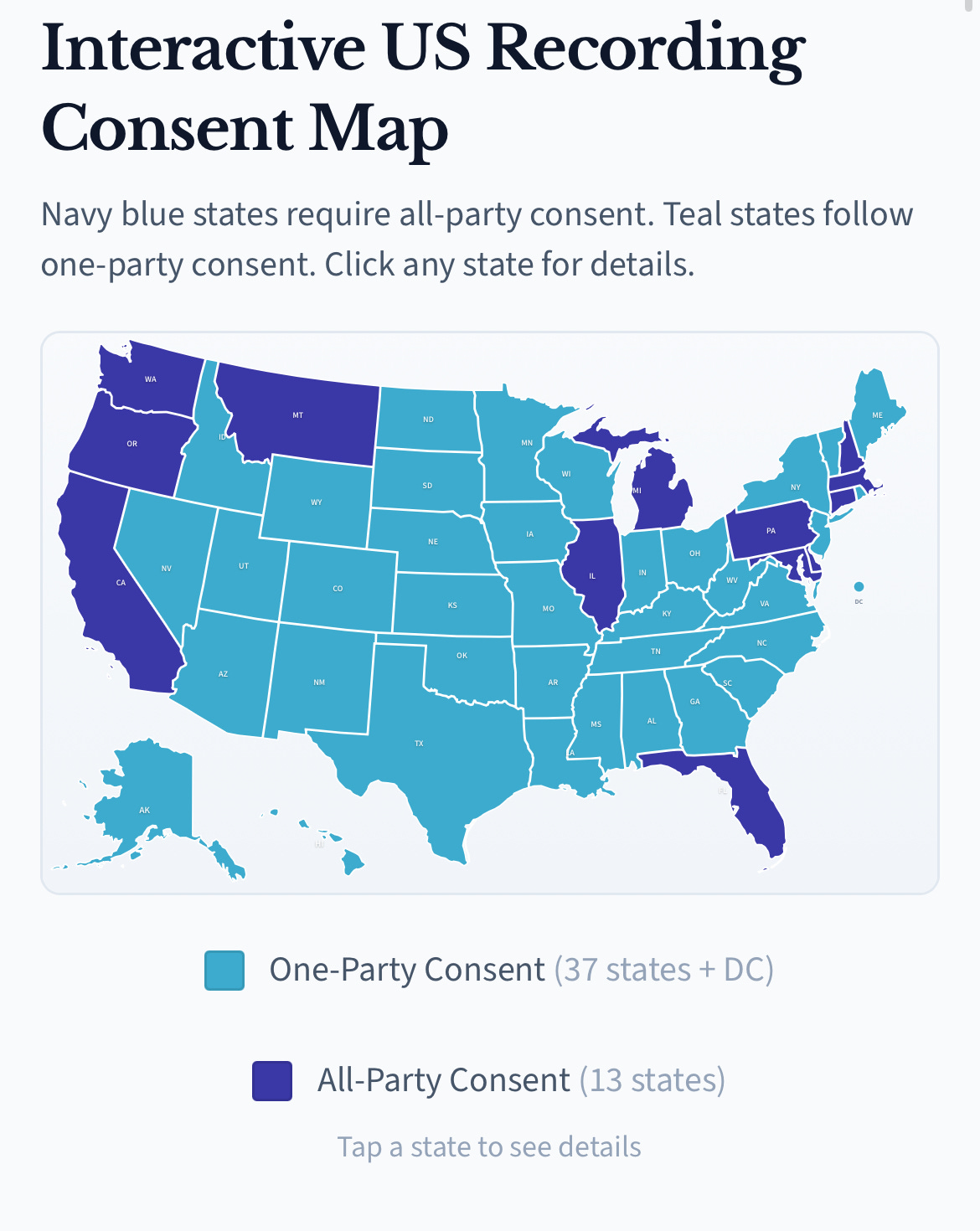
As you can see from the map above, more states have one-party consent laws, than two. One-party consent means that if your healthcare provider consents to being recorded, you, the patient, do not need to consent(as far as the law is concerned). The one-party consent states are the states that you may see more lack of consent issues, although your providers following best practices, will ultimately determine if proper consent is obtained for Ambient AI Listening devices, regardless of the law.
In a more broad context, 6 states have passed laws that require AI disclosure in healthcare.
California (Effective Jan 1, 2026)
Texas (Effective Jan 1, 2026)
Illinois (Effective various dates in 2025/2026)
*Indiana (Effective July 1, 2026 - upcoming)
*Tennessee (Effective July 1, 2026 - upcoming)
*Utah (Effective Jan 1, 2027 - upcoming)
*Note: While Indiana, Tennessee, and Utah have passed laws, their effective dates are later in 2026 or 2027. Texas, California, and Illinois currently have active disclosure mandates.
This means that if you live in one of the 6 states that have AI disclosure laws, your healthcare provider must disclose this to you before you receive treatment(or the first reasonable opportunity, in an emergency). These laws also extend to insurers and technology developers, to inform patients about the AI involvement in their care, or any related decisions about their care.
Conclusion
Many patients will welcome the advent of AI involvement healthcare, while they enjoy a technologically advanced experience in their care. Many will be more cautious, as regulators catch up to privacy concerns. There will also be those that want nothing to do with it. I predict that an entire alternate healthcare market will emerge, that is “AI free” healthcare. Many providers will reject it, and patients will flock to them, just as the patients who crave technology in their care, will flock to those that embrace it. The beauty of a free market, exists in this choice.
The ever present ai --- Big Brother's prsence continues to permeate our world and news of it comes out most every day. I don't care for it in any way, shape, or form. 😡 I'll try to be on the lookout more everywhere, as time passes.
Thank you for this info!